What Are Combo RFID Cards and Why Businesses Use Them
06/04/2026
06/04/2026

Businesses rarely operate with just one identification system. A hotel may need one card for room access, another for staff areas, and a different technology for parking or time tracking. A corporate office may use one system for door entry and another for printing, attendance, or cafeteria payments. When separate systems start to overlap, managing multiple cards quickly becomes inconvenient and expensive.
That is where combo RFID cards become especially useful. They are designed to combine more than one technology inside a single card, allowing one badge or card to work across different readers, systems, or security environments.
For companies that want to simplify access, improve convenience, and avoid carrying several credentials at once, combo RFID cards can be a practical and efficient solution.
Combo RFID cards are cards that contain two or more chip technologies in a single body. Instead of issuing separate cards for separate systems, a business can use one card that supports multiple functions.
A combo card may combine different RFID frequencies or combine contactless technology with another chip format, depending on the business need. The goal is simple: one card, several tasks.
These cards are especially useful when a company is upgrading its infrastructure, using multiple access systems at the same time, or serving users who must interact with different types of readers.
Inside a combo RFID card, there are multiple embedded components, each responsible for a specific technology. Depending on the card design, it may include:
When the card is presented to a compatible reader, the required chip responds. The user does not need to switch anything manually. The system reads the technology that matches the reader in front of it.
This makes the card convenient for everyday use while giving businesses more flexibility behind the scenes.
The biggest reason is integration. Many organizations do not operate in a clean, single-technology environment. They may have older systems that still work well, newer systems being added gradually, and different departments using different platforms.
Instead of replacing everything at once, businesses often choose combo cards to bridge these systems.
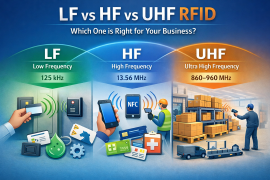
A business may already use LF cards for access control, while a new department or building uses HF or UHF. Rather than asking employees to carry two separate badges, the company can issue one combo card that works across both environments.
This is especially useful in:
System upgrades are rarely instant. Many businesses modernize in stages. They may want to keep the current access control system active while gradually introducing a new one.
Combo RFID cards make this transition smoother. The old system continues to function, while the new system is added without forcing immediate full replacement.
This reduces disruption and allows businesses to upgrade at a realistic pace.
Employees, guests, members, or contractors prefer carrying one card instead of several. Fewer cards mean less confusion, fewer losses, and easier day-to-day use.
For example, one combo card might allow a user to:
For the user, it feels like a simple badge. For the business, it means better organization.
Managing several credential types separately creates extra work. Printing, issuing, replacing, and tracking multiple cards costs time and money.
A combo card can reduce this complexity by consolidating functions into one physical product. This can improve internal processes, especially in organizations with many employees or high card turnover.
Some businesses need different technologies because the use cases are different. A short-range secure reader at an entrance may require one chip type, while long-range vehicle or asset identification may require another.
A combo card helps support these mixed environments without forcing the business to choose one technology for tasks it is not well suited for.
These are often used when a company has legacy low-frequency systems in place but also wants to support newer high-frequency or NFC-based applications.
This combination can be useful for:
This option is useful when a business needs both close-range identification and longer-range reading.
Typical examples include:
These cards are often chosen when a company needs one technology for interactive or secure close-range use and another for faster operational reading at distance.
This can be relevant in:
Combo cards are valuable wherever systems overlap. Common examples include:
A company may use one technology for office doors and another for printing, attendance, or cafeteria access. A combo card lets employees carry a single badge.
Hotels may combine guest room access, staff access, parking control, and internal service functions. One card can simplify both staff operations and guest experience.
Factories often have layered security and separate operational systems. Combo cards can help connect staff identification, access control, attendance, and process-related workflows.
Some facilities need close-range staff authentication together with long-range identification for goods, pallets, or vehicles. Combo solutions can support this mixed structure.
Campuses and healthcare institutions often use multiple systems across buildings, departments, and services. Combo cards help reduce friction for staff and authorized users.
The value of combo cards is not only technical. It is also operational.
Main benefits include:
For many businesses, the real advantage is that combo cards allow practical progress without forcing an all-or-nothing decision.
Combo RFID cards are useful, but they should be selected carefully. Not every combination is necessary, and not every system is automatically compatible.
Before ordering combo cards, businesses should evaluate:
It is also important to confirm how the card will be used in real conditions. A card that works well at a desk reader may behave differently at a gate, in a parking system, or in an industrial setting. Testing before large deployment is always the safer approach.
Not always. If a company uses only one simple access system and has no plans to expand or integrate with anything else, a standard single-technology RFID card may be enough.
Combo cards are most valuable when a business:
In those cases, a combo solution can save time, reduce friction, and support future growth more effectively.
Combo RFID cards are multi-technology cards designed to support more than one system in a single physical credential. Businesses use them because they simplify access, support infrastructure upgrades, reduce the need for multiple cards, and help different technologies work together more smoothly.
For companies dealing with mixed systems, phased modernization, or several daily use cases, combo RFID cards are not just a convenient option. They are often the most practical one.
The best choice depends on the technologies your business already uses, the systems you want to connect, and how you plan to grow in the future. When selected correctly, a combo RFID card can turn a fragmented identification setup into a much more efficient one.