LF vs HF vs UHF RFID: Which One Is Right for Your Business?
30/03/2026
30/03/2026
Choosing an RFID technology is not just a technical decision. It affects how fast you can identify items, how close tags need to be to the reader, how stable the system will work around metal or liquids, and how much value you will get from the investment over time. Many businesses make the mistake of thinking that all RFID works in roughly the same way. In reality, LF, HF, and UHF solve very different tasks.
If your company is planning to launch an RFID project, the right question is not “Which frequency is the most advanced?” but “Which frequency best fits my real operating conditions?” A warehouse, a hotel, a manufacturing line, a retail chain, and a fitness club may all use RFID, but they often need completely different solutions.
This guide explains the practical difference between LF, HF, and UHF RFID in clear language, so you can choose the option that actually works for your business.
These are three different RFID frequency ranges:
LF stands for Low Frequency.
HF stands for High Frequency.
UHF stands for Ultra High Frequency.
Each range has its own reading distance, data exchange behavior, resistance to environmental interference, and typical use cases. That is why the same tag that works perfectly for access control may be a poor fit for inventory tracking, and a tag designed for warehouse logistics may be excessive for a simple loyalty or membership card.
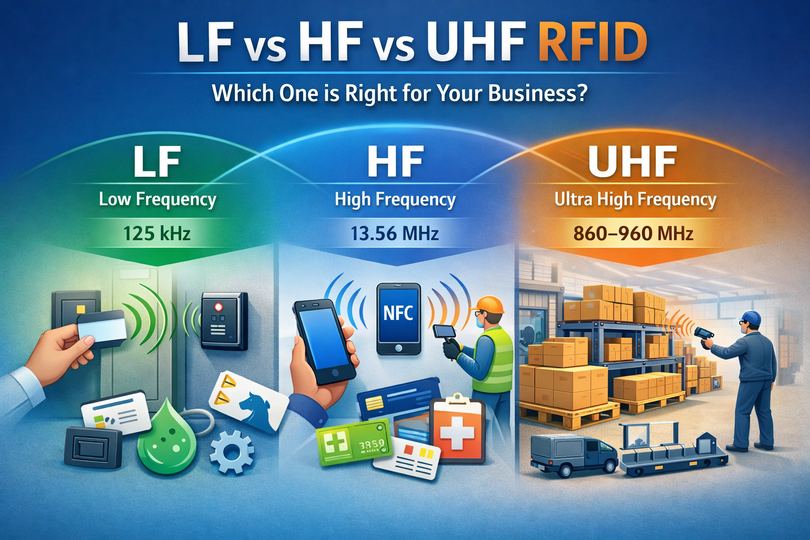
LF RFID usually operates around 125 kHz or 134.2 kHz. This technology is known for stable short-range reading and good performance in challenging environments.
The main strength of LF is dependability when the tag is close to the reader. It is less sensitive to water and moisture than higher-frequency systems, which makes it useful in applications where the environment is not ideal.
LF is commonly used for:
If a business needs a card, key fob, wristband, or tag that is presented very close to the reader, LF can be a strong option. It is often chosen where the priority is not speed over distance, but predictable reading at close range.
For example, LF is not the best choice if you want to scan multiple products in a warehouse or manage retail stock at speed.
HF RFID operates at 13.56 MHz and is one of the most widely used RFID technologies in the world. It combines convenience, security, and reasonable read distance for everyday business applications.
HF is often the best middle-ground option. It is more capable than LF in many digital use cases, while still being controlled and practical for secure, close-range interactions.
This category also includes NFC technology, which is especially important for businesses that want RFID interaction with smartphones.
HF RFID is widely used for:
For businesses that want customers or staff to intentionally tap a card, label, or device, HF is often the most logical choice.
If your company wants to combine identification with user interaction, HF gives much more flexibility than LF.
HF is excellent when deliberate close-range interaction is the goal. It is less effective when you need to identify many tagged objects across shelves, gates, or storage zones.
UHF RFID typically operates in the 860–960 MHz range, depending on region and system design. This is the frequency most businesses consider when they need long read range, rapid scanning, and the ability to track many items efficiently.
UHF is the strongest option for operational visibility. It is widely used in warehouses, retail, supply chains, and industrial environments where speed matters.
UHF is commonly used for:
If your business needs to identify items from farther away or read multiple tags in seconds, UHF is usually the leading candidate.
This is why UHF is often associated with supply chain modernization and retail efficiency projects.
If your goal is a secure office pass or an interactive NFC card, UHF may be the wrong tool even though it sounds more advanced.
To simplify the comparison, think about them this way:
A company choosing between them should focus on business process first, not on technical prestige.
One of the biggest mistakes is choosing a frequency based only on price. A cheaper tag can become more expensive if it slows down operations, creates read errors, or forces a redesign later.
Another mistake is copying another company’s setup without considering your own environment. Two businesses in the same industry may still need different RFID systems depending on their materials, workflows, reading distance, and integration goals.
It is also common to underestimate the importance of testing. Metal surfaces, liquid products, reader placement, and tag orientation can all influence results. The right RFID system is not just about the tag type. It is about how tags, readers, antennas, software, and the real physical environment work together.
There is no universal winner between LF, HF, and UHF RFID.
LF is the right choice when your business needs simple, close, reliable identification.
HF is the right choice when you need smart interaction, secure access, or NFC functionality.
UHF is the right choice when your business depends on speed, automation, and reading multiple items over greater distance.
The best RFID project starts with a clear understanding of what you want to identify, from how far, how fast, and in what environment. Once those answers are clear, the right frequency becomes much easier to choose.
A good RFID solution should not only work in theory. It should fit your daily business processes, reduce friction, and stay effective as your operations grow.